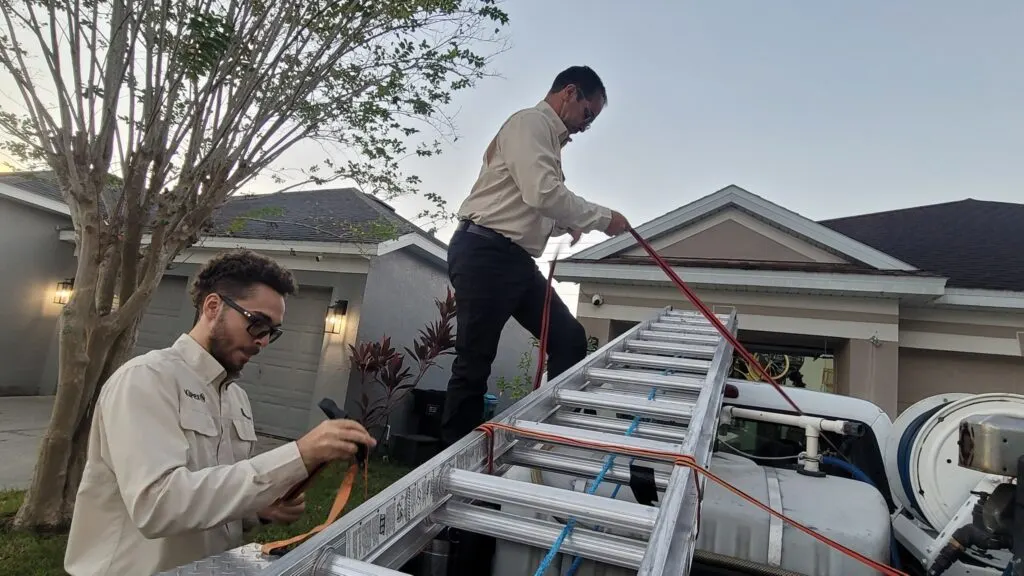
Signs of rats and mice in a Florida home
- Droppings like small black grains of rice: in the garage, attic, pantry or under sinks. Be very careful cleaning them, because they can carry diseases. Wear gloves and avoid sweeping them dry.
- Grease marks on downspouts: dark rub lines from the ground toward the roof show where rats are climbing.
- Branches touching or level with the roofline: roof rats are climbers and use trees as bridges.
- Holes in soffits or eaves: chewed or widened gaps along the roofline.
- Daylight under a closed garage door: if light gets through, so can a mouse.
- Scratching in the attic or walls at night: rodents are most active after dark.
- Gnaw marks: on stored boxes, pet food bags or wiring.
In Florida, roof rats are the rodents we meet most on rooflines and in attics. Mice need only an opening the size of a dime, and rats one the size of a quarter.
Our process, step by step
- InspectionWe look for activity, droppings, rub marks, and the gaps rodents use to get in, along garage corners, wooded edges and where pipes and wires enter.
- Exterior bait stationsBait stations are placed and maintained around the outside of the home.
- Interior trapsWe also place traps inside the attic and any other accessible areas as a precaution, whether or not we see signs of damage.
- Attic and roof checkA visual check of the attic and roofline for signs of entry.
- ExclusionWhen rodents are already inside, entry points are sealed as a dedicated project, quoted after the assessment.
Included in Total Home Shield
Total Home Shield includes exterior rodent bait stations maintained around the home, an attic and roof visual check at the initial visit, and a $300 wildlife exclusion credit. Stations can also be added to Essential or Premium.
Simple steps that help
- Trim branches back so they do not touch the roof.
- Store pet food and birdseed in sealed containers.
- Fix garage door seals that let light through.
- Keep stacked wood and clutter away from the walls.
- Pick up fallen fruit from citrus and other backyard trees, which roof rats are happy to eat.
Rats and mice also breed quickly, so a couple of sightings can turn into a real problem within a season. Acting on the first signs is always cheaper and easier than waiting. None of these replace sealing the gaps, but they make your home a lot less inviting while we do.
What makes Kilpex different
Most rodent problems start outside, so we work from the outside in. Edgar and Giann point out the exact worn spots and gaps on your home, so you understand what is happening instead of just hearing that you have rats. Exclusion work is priced in person after a free assessment, because what it takes depends on how your home is built.
Kilpex has been family-owned since 2007, and the same family team comes back to maintain your stations.
Areas we serve for rodent control
Wooded lots and older homes keep rodents active in parts of our service area. We serve greater Orlando only, from our family office at 3662 Avalon Park E Blvd, Suite 2025.
- Rodent control in Lake Nona
- Rodent control in Avalon Park
- Rodent control in Oviedo
- Rodent control in Celebration
Close to one of these communities but not sure we reach your street? See all service areas or call (407) 375-2167 and we will confirm.
Rodent control questions
How small a gap can a rat or mouse use?
Mice need only an opening the size of a dime, and rats one the size of a quarter.
How do rats get onto my roof?
Roof rats climb. Tree branches touching or level with the roofline, and downspouts, give them a path up to soffits and eaves.
Should I clean up rodent droppings myself?
Be very careful if you do, because droppings can carry diseases. Wear gloves, avoid sweeping them dry, and call us if there is a lot of it.
Are rodents worse at certain times of year?
Rodents are active year-round here, but activity inside homes often picks up when weather turns cooler or after heavy rain, as they look for dry, sheltered spots. Wooded lots keep pressure steady all year.
Is exclusion included in rodent service?
Exclusion is quoted separately after a free assessment, because what it takes to seal a home depends on how it is built and what we find.